
or, Everything You Wanted To Know About Circular Saw Blades, But Were Too Afraid To Ask
Do you know if you have the correct circular saw blades installed in your workshop machinery and/or power tools for the material that you’re cutting? If you don’t know 100%, or you’re in any way unsure, then you really, really need to read this blog.
Up until very recently, I thought all circular saw blades were created pretty much equally. With the only real variation being in their diameter, the number of teeth they have and bore size. Factors that are somewhat determined by the type of machinery/power tool they’re going to be fitted into. Also, whether you’re making rip cuts or cross/mitre cuts, and/or how smooth a finish you wanted.
I had no idea that there were other variables that should be to be taken into consideration when selecting circular saw blades for any workshop machinery, or power tool task.
Disclaimer: And before we get into it; Yes, I know I harp on about Japanese Saws all the time. But, I also make no secret of the fact that I do use workshop machinery and power tools, when the need arises. Especially, if I’m making multiple, repeatable cuts, or need to resaw some reclaimed wood I’ve rescued for my creations. So, give me a break. Okay..?
Also (if you’re of a squeamish nature); No bodily parts were removed or harmed in the making of this blog (thankfully). So, you’re safe to read this blog in its entirety.
Also, also; #NotSponsored
Wake Up Call
The Incident
What spurred me into finding out more about circular saw blades, you may well ask? I shall now reveal.
Gillette and I were creating skis for a utility shed we were constructing in the garden. I was cutting some 2x6s to length with my mains powered, 184mm Ryobi hand-held circular saw (that I brought back from Australia). This had a 60-tooth Freud Diablo blade fitted (which I also brought back from Australia). My Ryobi takes blades with a 15.88mm (5/8″) bore, but the Diablo blade has a 20mm bore. So, I had one of those bushing washers fitted to compensate. In the decades I’ve been using circular saw blades, I’ve never run into any issues in use.
As I was making one of the cross cuts into the 2×6 (running the Ryobi along a speed square), I felt a percussive jolt, then the noise and vibration the saw was making instantly told me the tool wasn’t happy. I immediately stopped the cut, waited for the saw to stop spinning, then removed the saw from the cut. #SafetyFirst
The Issue
At first glance, I couldn’t see anything wrong with the saw or blade. Nor was there any smoke or funny smell emanating from the motor. On closer inspection, however (once I’d unplugged it from the mains power, obviously), it transpired that the bushing washer had completely removed itself from the blade, for whatever reason. This meant that the blade was off-centre and, when the saw was operating, the blade teeth had an eccentric orbit around the spindle due to centrifugal force.
No wonder the saw wasn’t happy. I forlornly removed the blade (and bushing) from the saw spindle. As I didn’t have a replacement bushing (and it was a Sunday), I had no choice but to finish the rest of the cuts with my Ryoba-noko. #TennisElbow
You Don’t Know What You Don’t Know
The following day I started to look for a replacement bushing washer, and also contemplated whether I should buy new saw blades for all of my workshop tools. They have seen some use, and some have been in storage for a while. I probably should replace them, but as finances were a little tight, the bushing washers option won out (for now).
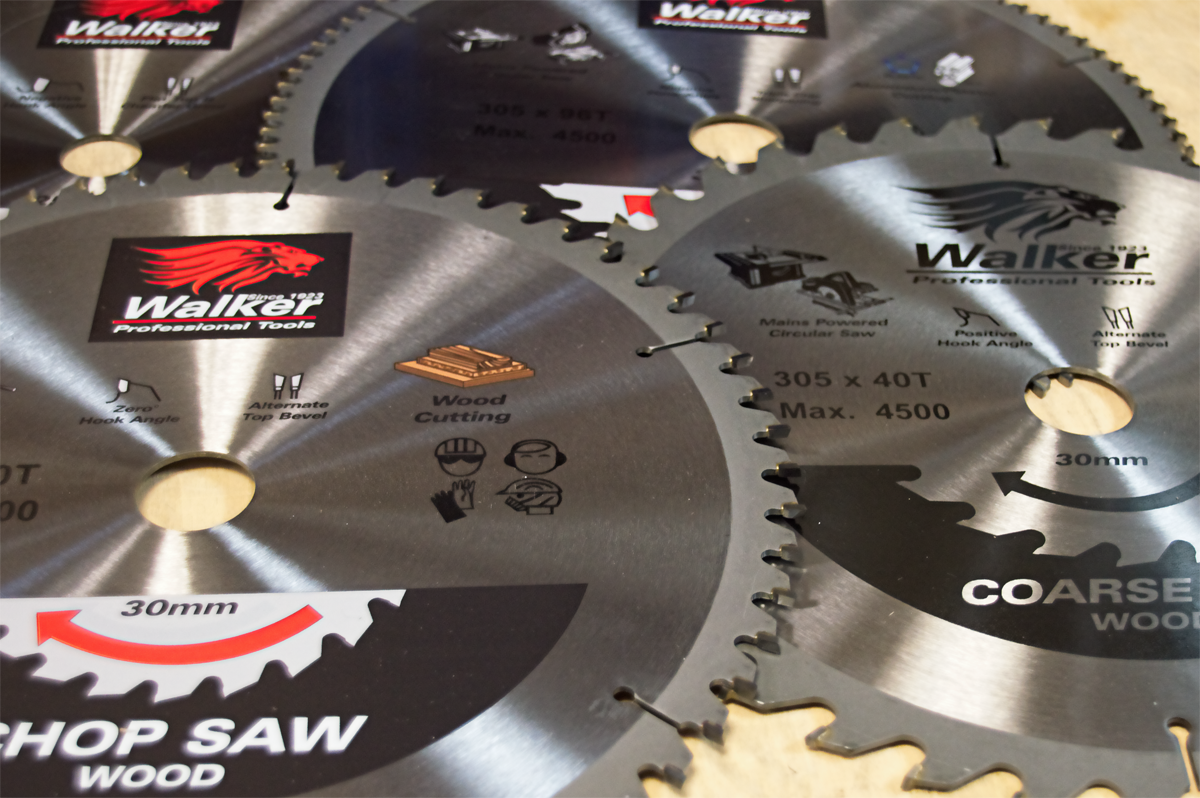
It was whilst searching online that I stumbled across a company, called Walker Tools, who supply circular saw blades. They also sell the bushing washers I was searching for. But, more excitingly (to me, anyway), they are based right here in Sheffield. Woohoo..! #BuyLocal
Browsing their site, I came across a blog post that gave a fairly brief rundown on the various types of circular saw blades and what they should be used for. I wish to pass this knowledge along to anyone who is unsure, and this is what I found out.
Slave To The Grind
The majority of all circular saw blades are TCT, which (if you didn’t already know) stands for Tungsten Carbide Tip(ped). A blob of tungsten carbide is brazed onto the tip of each tooth of the saw blade, which is then ground down to a sharp finish (‘cus, it’s easier to cut with things that have a knife edge, than with things that have the profile of a pebble).
What I hadn’t realised, is that there are different grind profiles on TCT that are dependent on the type of material you wish to cut.
Alternate Tooth Bevel
As I predominantly work with wood, the Alternate Tooth Bevel (ATB) grind is the only style of tip I’ve ever seen on circular saw blades. Each tip has a bevel ground into its top surface, with the direction of the bevel sloping in the opposite direction, every alternate tooth.
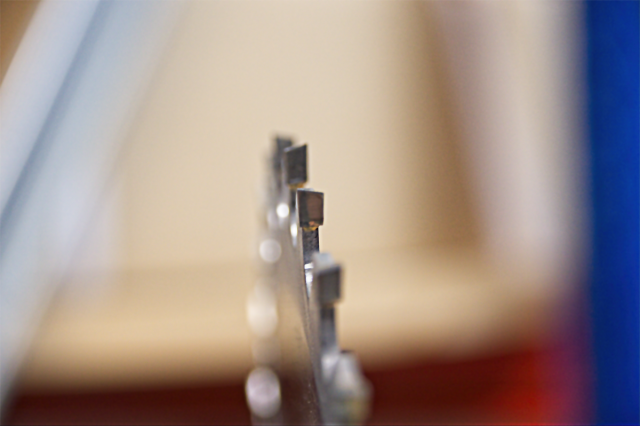
An ATB grind is perfect for use on wood, as it works equally well for rip cuts as it does for cross/mitre cuts. I have used these blades for cutting sheet plastic materials, but that’s because I didn’t know any better.
Triple Chip Grind
This is the grind I should have been using to cut the acrylic sheets, I mentioned above. The Triple Chip Grind (TCG) features teeth with a flat top, tangential to the circular saw blade. Then, every alternate tooth has a chamfer on both sides of the tip. This configuration means that the chamfered tooth creates a groove in the material, then the unchamfered tooth clears out the remaining material.
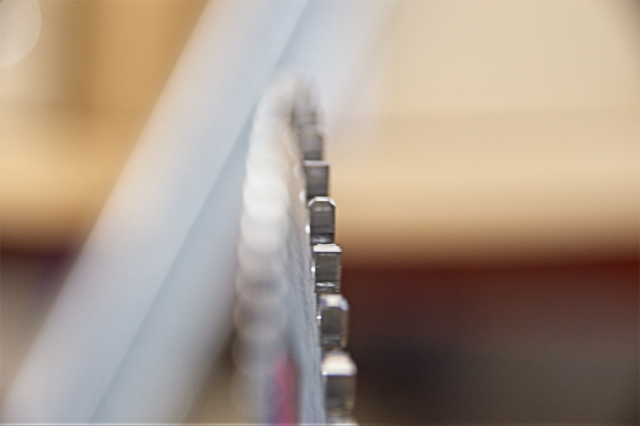
The TCG should be used whenever you wish to cut soft metals (such as aluminium) and plastics.
Special Bevel Sharpening
If you wish to cut harder metals, such as steel, then you’ll require a Special Bevel Sharpening grind on your TCT circular saw blades.
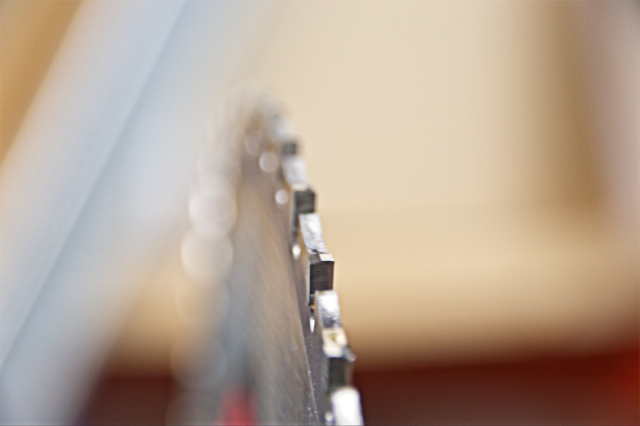
I am unsure as to the safety aspects of cutting steel sheet on a table saw or steel profiles on chop/mitre saw, especially if you’re just a home crafter or DIYer. I certainly wouldn’t attempt it. But (as I’ve mentioned in other blog posts), I’m not your mother. So, if you are going to attempt this (for whatever reason), then be safe and also make sure you have the Special Bevel Sharpening grind on your circular saw blades.
Swift Right Hook
Another factor of circular saw blades (that I was completely oblivious to) is the hook angle (aka; rake) of the teeth. Hook/Rake is how much the teeth lean into or away from the cut as the blade rotates. If the teeth lean into the cut, this is referred to as “Positive Hook/Rake”. If the teeth lean away from the cut, this is (unsurprisingly) referred to as “Negative Hook/Rake”.
Positive Hook/Rake [Up To +30°]
Circular saw blades with a positive hook/rake have a more aggressive cut. This is due to the teeth leaning into the cut, which pulls the material into the saw blade. This provides a faster cut, but at the expense of leaving a rough finish. However, the roughness of the finish can be somewhat counteracted by using a blade with more teeth.
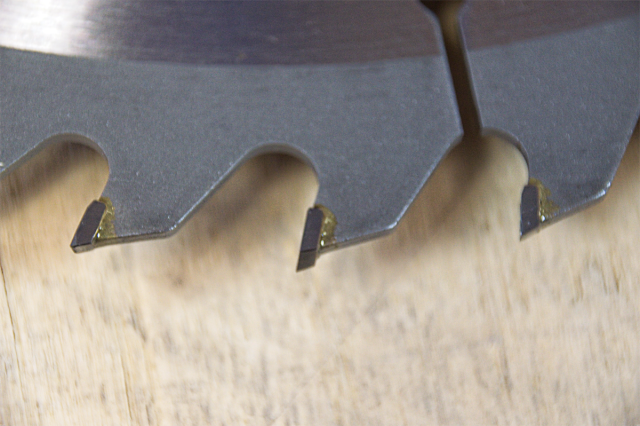
You should only use positive hook/rake circular saw blades with table saws and hand-held circular saw tools if you are cutting wood.
Negative Hook/Rake [Down To -10°]
Circular saw blades with a negative hook/rake have the least aggressive cut. This results in a slower cut that produces a much cleaner finish. The negative hook/rake acts in the opposite way to a positive hook/rake. So, when used on a chop/mitre saw, it pushes the material down and against the table and fence.
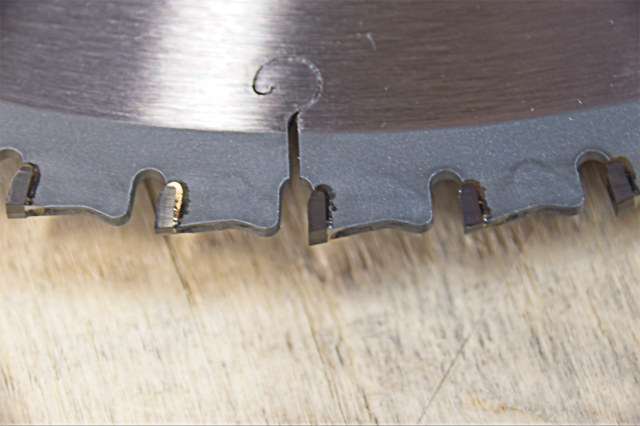
You should use negative hook/rake circular saw blades for cutting metals and plastics, irrespective of what tool you’re using to make the cut. These blades should also have either a Special Bevel Sharpening or a TCG, respectively.
Zero Hook/Rake [0°]
Circular saw blades with a zero hook/rake have a cut aggressiveness that falls somewhere in between the other two hook/rake angles (obviously). These blades are specifically designed for use in chop/mitre saws and are for cutting wood only.
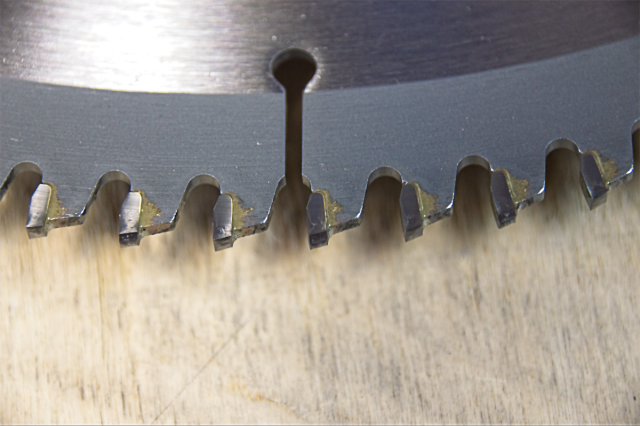
As the blades in such machines are being brought down onto the material, the zero degree hook/rake angle (again) pushes said material down and against the saw table and fence. In exactly the same way as circular saw blades with a negative hook/rake.
In The Thick Of It
Did you know that there is one huge difference between circular saw blades made for a mains-powered hand-held tool, compared to one made for a cordless, battery-powered version? ‘Cus I bloody well didn’t.
It’s all down to the thickness of the blade. Cordless hand-held tools use thinner blades that weigh less (than their mains-powered counterparts) and thus put less strain on the battery. Which means that the tool doesn’t have to work as hard to spin the blade up to the correct speed (and keep it spinning at that speed whilst cutting), therefore the batteries last longer.
From what I’ve been told, this is a very common mistake that people make. So, please make sure to check with your supplier, when ordering blades for hand-held tools, that you are purchasing the correct type.
Care & Safety
It appears that gone are the days of washing circular saw blades in hot, soapy water with a toothbrush, to remove wood resins and increase longevity. Users these days seem to view circular saw blades more as consumables, rather than machine/tool accessories (such is the “throw away” society that we have sadly become).
But, if you stick to the guidelines described above, for selecting the correct blade for your machine/tool and the material you wish to cut, then you should be able to keep cutting for a good while. I would also suggest inspecting your blades regularly. Check to see if any of the TCT are chipped, broken or completely missing. If you find any that are, then it’s probably time to buy a new blade.
If your blade is no longer usable, then please dispose of it responsibly. Circular saw blades are made from steel, so can easily be recycled. Don’t just throw it in with the general household waste, take it to your nearest recycling centre or scrap metal dealer.
Now You Know
You are now armed with exactly the same knowledge I have (about circular saw blades, that is). And you’re in a better position to make an informed decision, when selecting all future circular saw blades for your machinery and tools. If you’re still in any doubt, then please do get advice from professionals before cutting anything, with potentially the wrong circular saw blade fitted. Don’t look at me, though. I’d never consider myself to be a professional anything (well, maybe procrastinator, if only I could get paid for it).
If you’ve read this far, then here’s a bonus for you if you’re looking to purchase new circular saw blades. Walker Tools have graciously given me a discount code to use for purchases on their website. Use the code ‘SILVERHAND’ at checkout and get 10% off your order. To be clear, this is purely for you. I do not get any backhanders or kickbacks for you using this code. You’re welcome.
Be safe,
C…
Further Reading And Footnotes
I’d like to acknowledge Sam, over at Walker Tools, who was an absolute star and was extremely helpful (and patient) when I fired over a barrage of questions, when compiling this blog. And also for the above 10% discount code for their website. So, not only do you get educational content from my blogs, but also money off stuff too..! Blimey.
For more information about me and all that is Silverhand Creative, go check out the About Me page on this website. I have a presence on Instagram and Facebook, where I post photos (and the odd video) of ongoing and finished projects. There’s also a YouTube channel, where you can see how I go about doing what I do and what tools I prefer to use. So, feel free (there’s no pressure) to follow and/or subscribe to any (or all) of the above.
I am most definitely amenable to commission work and have a web form for you to get in touch, should you be looking for something a little more custom.
All trademarks (registered or otherwise) used in this blog lie solely with their respective owners.